







As Botswana advances its national development agenda—focused on infrastructure expansion, urbanization, and industrial growth—the country faces a growing waste management challenge. Rapid construction of roads, buildings, and industrial facilities generates massive volumes of construction and demolition (C&D) waste, while urbanization increases municipal solid waste (MSW) from households and businesses. Industrial activities, including mining and manufacturing, add process by-products that often end up in landfills, straining limited disposal capacity and threatening Botswana’s pristine ecosystems. To balance development with environmental protection, Botswana seeks solutions that turn waste from a liability into an asset. DongMeng, a global leader in waste resource utilization, has introduced tailored waste transformation systems to Botswana—turning C&D waste, MSW, and industrial by-products into reusable resources, reducing environmental impact, and helping the country build a "green legacy" for future generations.
Integrated C&D Waste Recycling: Powering Sustainable Infrastructure
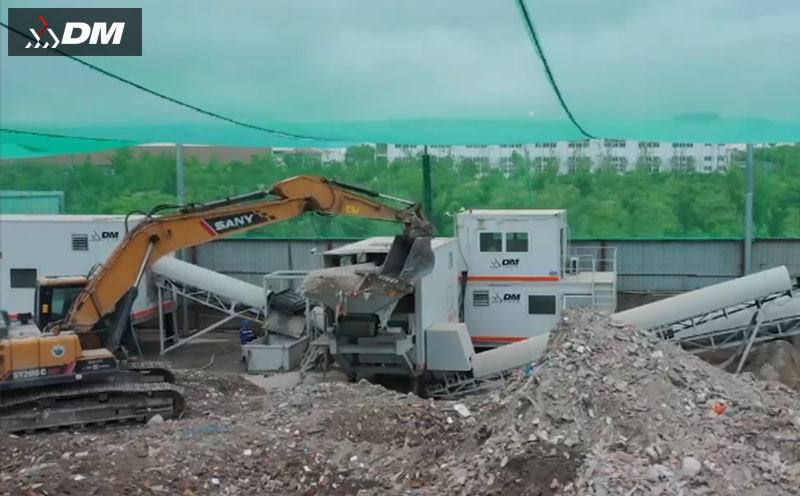
Botswana’s infrastructure boom—driven by road networks, housing projects, and mining-related construction—generates over 500,000 tons of C&D waste annually, including concrete, bricks, asphalt, and steel reinforcement. Most of this waste was historically dumped in landfills, occupying valuable land and posing environmental risks. DongMeng’s integrated C&D waste recycling systems offer a sustainable solution, transforming this waste into high-quality recycled aggregates for use in new construction.
The recycling process follows a precise, multi-stage workflow: First, C&D waste is fed into a mobile or fixed primary crusher, which breaks down large chunks (up to 1200mm) into manageable fragments. Next, a vibrating screen separates soil, dust, and fine particles from the crushed material. Then, a secondary impact crusher refines the material into graded aggregates (4-40mm), while magnetic separators and air separators remove steel, plastic, and other contaminants. The final recycled aggregates meet Botswana’s BS 8500 concrete standards, making them suitable for road bases, concrete mixing, and building foundations. A single DongMeng recycling plant can process 80-300 tons of C&D waste per hour, with a resource recovery rate exceeding 95%.
This transformation delivers tangible benefits: For Botswana’s Department of Roads, recycled aggregates from DongMeng’s plants have reduced the need for natural stone mining by 40% in recent highway projects, conserving natural resources and lowering carbon emissions from quarrying. For construction companies, using recycled aggregates cuts material costs by 25-30% compared to natural aggregates, while diverting waste from landfills extends the lifespan of disposal sites. By closing the loop between construction and recycling, DongMeng’s systems support Botswana’s vision of sustainable infrastructure development.
Municipal Solid Waste (MSW) Treatment: Creating Circular Value for Cities
Botswana’s urban centers, such as Gaborone, Francistown, and Maun, face rising MSW volumes—estimated at 1.2 million tons annually—comprising organic matter (45%), plastics (20%), paper (10%), and inert materials (15%). Traditional landfill disposal not only wastes valuable resources but also generates methane, a potent greenhouse gas, and risks contaminating soil and groundwater. DongMeng’s integrated MSW treatment systems address this challenge by extracting circular value through sorting, composting, and recycling.
The MSW treatment process begins with mechanical sorting: Automated screens, magnetic separators, and optical sorters separate recyclables (plastics, metals, paper) from organic waste and inert materials. Organic waste is processed into high-quality compost via aerobic fermentation—rich in nutrients, this compost is ideal for improving soil fertility in Botswana’s semi-arid agricultural lands, reducing reliance on chemical fertilizers. Inert materials (glass, ceramics) are crushed into aggregates for road construction, while non-recyclable plastics are converted into solid recovered fuel (SRF) for use in industrial boilers, replacing fossil fuels. Recyclable materials are baled and sent to local recycling facilities for further processing, creating jobs and supporting a domestic circular economy.
In Gaborone, a DongMeng MSW treatment plant processes 300 tons of waste daily, diverting 85% of MSW from landfills. The compost produced is supplied to nearby farms, increasing crop yields by 20-25%, while recycled plastics are transformed into packaging materials for local businesses. This system not only reduces environmental pollution but also generates economic value, turning urban waste into a resource that supports agriculture and industry in Botswana.
Industrial By-Product Utilization: Reducing Mining & Manufacturing Footprints
Botswana’s mining and manufacturing sectors—key drivers of the economy—generate significant industrial by-products, including coal ash from power plants, mine tailings from diamond and coal mining, and metal scraps from manufacturing. These by-products, if improperly managed, can cause soil and water pollution. DongMeng’s specialized treatment systems convert these industrial wastes into valuable products, reducing the environmental footprint of key industries.
For coal ash—produced in large quantities by Botswana’s coal-fired power plants—DongMeng’s processing system separates fly ash and bottom ash. Fly ash is used as a supplementary cementitious material in concrete production, improving strength and durability while reducing cement usage (a major source of carbon emissions). Bottom ash is processed into aggregates for road construction or used as a base material in landfill engineering. For mine tailings, DongMeng’s mineral recovery technology extracts residual valuable minerals (e.g., diamond micro-particles, copper) through advanced sorting and beneficiation, while the remaining material is stabilized and used for land reclamation or as construction aggregates.
At a coal-fired power plant in Selebi-Phikwe, DongMeng’s system processes 50,000 tons of coal ash annually, supplying 30% of the fly ash used by Botswana’s cement manufacturers. This not only diverts coal ash from landfills but also reduces cement production emissions by 18%, aligning with Botswana’s climate goals. For mining companies, tailings utilization reduces disposal costs and creates additional revenue streams, demonstrating how industrial waste can be a catalyst for sustainable growth.
Flexible, Climate-Adaptive Design: Thriving in Botswana's Conditions
Botswana’s unique environmental conditions—semi-arid climate, high temperatures (up to 40°C), dust storms, and limited water resources—demand waste treatment equipment that is robust, energy-efficient, and water-saving. DongMeng’s systems are designed with these conditions in mind, ensuring reliable performance while minimizing resource consumption.
The equipment is available in mobile, semi-mobile, and fixed configurations to adapt to Botswana’s diverse waste generation scenarios. Mobile units—equipped with tracked chassis—can be deployed directly to construction sites or remote mining areas, processing waste on-site and reducing transportation costs. Fixed facilities are installed in urban centers for large-scale MSW treatment, while semi-mobile systems cater to medium-sized industrial operations. All systems feature energy-efficient motors and optimized processing workflows, reducing power consumption by 15-20% compared to conventional equipment.
Water conservation is a key design priority: Closed-loop water circulation systems reuse water for dust suppression and equipment cooling, with a recycling rate exceeding 90%, minimizing reliance on Botswana’s scarce groundwater. Dust control systems—including sealed processing chambers, pulse bag filters (dust removal efficiency ≥99.8%), and spray suppression—reduce airborne particles to ≤5mg/m³, complying with Botswana’s strict environmental standards. The equipment’s corrosion-resistant coatings and dust-proof enclosures protect critical components from sandstorms and high temperatures, ensuring long service life in harsh conditions.
As Botswana builds a prosperous future through development, DongMeng’s waste transformation solutions are ensuring this growth is sustainable—turning waste into resources, protecting ecosystems, and creating economic value. From recycling construction waste for roads to converting municipal waste into compost and industrial by-products into manufacturing inputs, DongMeng is helping Botswana write a "green legacy" that balances progress with environmental stewardship. By fostering a circular economy, these solutions not only address immediate waste challenges but also build resilience for future generations—supporting agriculture, creating jobs, and reducing carbon emissions. As Botswana continues its development journey, DongMeng remains committed to innovating waste transformation technologies, integrating AI-based sorting, renewable energy integration, and advanced material recovery to deliver even greater environmental and economic benefits. Together, Botswana and DongMeng are proving that development and sustainability can go hand in hand—building a greener, more prosperous nation for all.
If you would like to get help immediately, you can also fill your requirements on the following form, we will contact you on the right time.


Get In Touch