







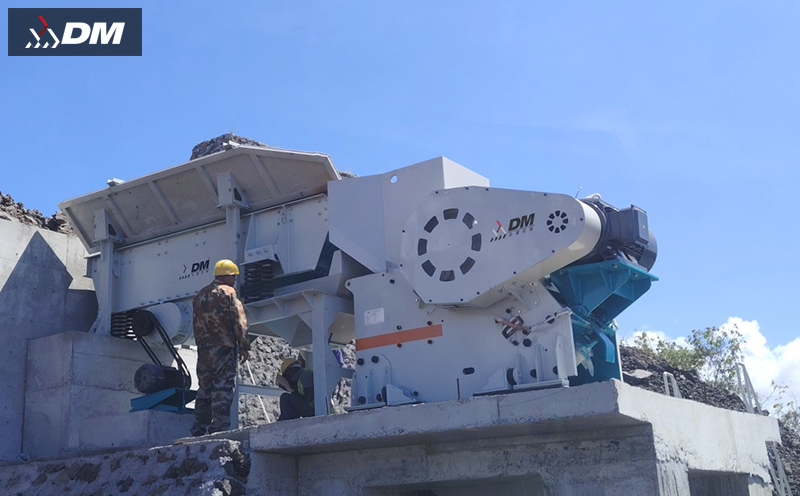
I. The "Crushing Dilemma" of Botswana's Hard Rock Diamond Mines: Dual Tests of Hardness and Efficiency
As the world's second-largest diamond producer, 80% of Botswana's diamond resources are embedded in hard rock formations such as kimberlite. These formations are tantamount to the "ultimate test" for crushing equipment: Kimberlite has a Mohs hardness of 7-9 and is interspersed with a large number of hard minerals such as garnet and olivine, making the impact wear intensity on crushing components 5 times that of ordinary ores; the formations are deeply buried, with some open-pit mines exceeding 200 meters in depth, and ore transportation costs accounting for 30% of the total, requiring "on-site crushing" to reduce transportation pressure; diamond mining lines adopt a "continuous separation" mode, where shutdown of any link will cause the entire process to halt, with hourly shutdown losses exceeding 500,000 Pula.
Traditional crushers frequently "fail" in such working conditions: A diamond mine once had to shut down for jaw plate replacement every 10 days due to excessive wear, resulting in over 60 hours of monthly maintenance; equipment at another mine suffered bearing fracture due to inability to withstand hard rock impact, halting the production line for 3 days and causing direct losses of 1.5 million Pula. The industry consensus has been formed: In Botswana, the "wear resistance" and "operational stability" of crushers directly determine the production capacity and revenue of diamond mining lines. Only equipment capable of tackling hard rock can safeguard the "lifeline" of mining lines.
II. Core Breakthrough: Hard Rock-Specific "Efficient Wear-Resistant + Stable" Design
Our mine crushers, custom-built for Botswana's hard rock diamond mines, take "tough structure against impact, ultra-wear-resistant material against abrasion, and intelligent system for stability" as the core. Through six key technological innovations, they achieve efficient and continuous operation in hard rock environments. Their core advantages are reflected in three systems:
1. Ultra-Wear-Resistant Crushing System: The "Terminator" of Hard Rock Abrasion
Targeting the high hardness of kimberlite, the equipment adopts a "gradient reinforcement + impact-resistant design": Crushing chamber liners are made of independently developed "high-chromium alloy + tungsten carbide composite material", reaching HRC70 hardness after 1200°C high-temperature quenching, with diamond wear-resistant particles inlaid on the surface. Wear resistance is 4 times higher than ordinary high-manganese steel, and service life is extended to 150 days; Jaw plates adopt an "arc curved surface" structure, increasing contact area with ore to disperse impact stress of hard rock and avoid local cracking; The discharge port is equipped with adjustable wear-resistant grates, which can control finished product particle size (accurate to 5-20mm) and block large impurities from jamming. In field tests at the Orapa Diamond Mine, the equipment crushed 42,000 tons of hard rock ore in a single month, reducing liner replacement frequency from 3 times/month (traditional equipment) to 0.2 times/month, and cutting abrasion costs by 85%.
2. Tough Power and Structure: The "Shield" Against Impact
To cope with hard rock impact and heavy-load operation, the equipment is equipped with a "super high-power power unit + reinforced structural frame": A 16-cylinder turbocharged engine with a rated power of 680kW is selected, which can easily drive the crushing chamber to perform "high-intensity extrusion crushing" on grade 9 hard rock. Processing capacity is 60% higher than traditional equipment, with a single unit crushing 1,500 tons of hard rock daily; The frame adopts an integral steel casting process, with wall thickness increased by 40%. Key welds are treated with "double-arc welding + stress relief", improving impact resistance by 50% and avoiding deformation or cracking under continuous hard rock impact; The hydraulic system is equipped with "three-stage overload protection", which automatically relieves pressure and shuts down when encountering uncrushable hard objects, preventing rigid equipment damage. In heavy-load tests at the Jwaneng Diamond Mine, the equipment crushed high-hardness kimberlite continuously for 72 hours without any damage to core structures.
3. Intelligent Maintenance System: The "Smart Brain" for Stable Operation
The equipment is equipped with a multi-dimensional sensor network and cloud-based maintenance platform, realizing "fault prediction + precise maintenance": Vibration sensors real-time monitor liner wear, sending replacement reminders 72 hours in advance when thickness falls below the critical value; Temperature sensors track bearing and hydraulic oil temperatures, automatically activating forced heat dissipation when abnormal heating occurs to avoid "thermal failure"; The cloud platform enables remote diagnosis of equipment operating parameters, allowing engineers at the Gaborone maintenance center to troubleshoot equipment at northern mines, shortening maintenance response time to 4 hours. Data shows that the intelligent system achieves a 95% predictive maintenance rate for the equipment, reducing unplanned downtime from 45 hours/month to 5 hours, and increasing effective operating time by 22%.
III. Practical Verification: "Continuous Operation Revolution" of Diamond Mining Lines
In 2023, a large diamond mining company in Botswana introduced 18 units of this custom crusher at the Orapa and Jwaneng mines, replacing the original traditional equipment and achieving subversive improvements in mining line operating data:
- Average equipment availability increased from 68% to 96%; monthly average effective operating time of mining lines rose from 520 hours to 700 hours; diamond ore processing capacity increased by 35%, and diamond recovery rate improved by 8%;
- Monthly average procurement cost of wear parts decreased from 2.4 million Pula to 400,000 Pula; maintenance labor costs were reduced by 70%; crushing cost per ton of hard rock dropped from 65 Pula to 32 Pula;
- Shutdown losses caused by equipment failures decreased from 1.5 million Pula/month to zero; 3 potential shutdown risks were successfully avoided, recovering losses exceeding 4.5 million Pula;
- "On-site crushing" reduced ore transportation distance from 15 km to 2 km, cutting transportation cost per ton by 87% and saving over 12 million Pula in annual transportation expenses.
The production director of the mining company stated: "Botswana's diamonds are hidden in hard rock. Only equipment that can 'bite through' hard rock and keep running is truly capable. This set of crushers has achieved 'zero-interruption' operation of our mining lines, with diamond output and revenue reaching new highs."
IV. Adaptation and Maintenance Guide for Botswana's Hard Rock Mines
Combined with the working condition differences of different hard rock diamond mines in Botswana, precise planning is required to maximize equipment value:
1. Working Condition Adaptation Selection Recommendations
- Deep high-hardness kimberlite mines (e.g., Orapa): Prioritize jaw + cone combined crushing units to enhance impact and wear resistance in primary and secondary crushing links;
- Shallow scattered hard rock mining sites (e.g., Kgalagadi): Select crawler-type mobile crushing plants, adapting to transfer needs of multiple mining sites and achieving "on-site crushing and nearby separation";
- Large open-pit mines (e.g., Jwaneng): Choose fixed crushing production lines, paired with belt conveyor systems and central control rooms, to achieve large-scale continuous production.
2. Localized Maintenance Tips
- Establish a wear database: Record the correspondence between ore hardness, impurity content, and wear part life in different mining sections to formulate personalized replacement plans;
- Heavy-load protection: Daily inspection of frame welds and hydraulic system seals, weekly application of anti-wear grease to bearings, and monthly comprehensive stress testing.
- Intelligent system integration: Dedicated personnel monitor cloud data in real time to ensure early warning responses within 10 minutes, enabling early fault detection and maintenance intervention.
Conclusion
Botswana's hard rock deposits contain the world's top diamond resources, but their high hardness and high wear were once a major constraint on production capacity. Our customized mining crusher, with its ultra-wear-resistant crushing system, tackles the tough rock, its robust structure withstands head-on impact, and its intelligent operation and maintenance system ensures uninterrupted operation, transforming these mining challenges into production advantages. In the deep mines of Orapa and the open-pit mine of Jwaneng, this equipment, with its exceptionally high 96% availability rate, proves that there's no need to compromise between crushing efficiency and equipment stability when tackling Botswana's hard rock deposits. Choosing the right crusher capable of tackling hard rock can keep diamond production lines running continuously, transforming underground "gem resources" into a continuous stream of economic benefits.
If you would like to get help immediately, you can also fill your requirements on the following form, we will contact you on the right time.


Get In Touch